‘Free traders’ deplore nationalist protectionism, but push North American protectionism, USMCA tariff
Duplicity, deception evident as globalists line up to promote USMCA ‘Fortress North America’ tariff alignment against China
by Tim Porter
CircumspectNews.com
July 9, 2026
“Free trade” advocates were not supposed to be fond of tariffs. “Free trade” was going to take us beyond tariffs, branded by “global citizens” as the protectionist tool of nationalists, xenophobes and tribalism.
Leading up to President Trump’s July 1 decision not to renew, as is, the North American USMCA trade agreement with Mexico and Canada, observers were provided another reminder that “free traders” are actually on board with tariffs – when tariffs suit the purposes of globalism.
COVID, Ukraine and other geopolitical crises had already revealed the naivety of the globalist “free trade” worldview, as over-stretched global supply chains proved frail and vulnerable to breakdown. Open borders allowed non-vetted masses into nations under the “free trade” mantra, “free movement of goods, services and people.“
Chaos naturally followed: Drug gangs, human trafficking, labor law violations, terror cells, and distress of nations proliferated. Meanwhile, tariffs and non-tariff barriers, imposed by other nations against U.S.exports, had remained in place for decades. China, Japan, India, and EU nations were the most notable of many to limit access to their markets under this practice.
Non-reciprocated, these tariffs became de facto covert foreign aid. American wealth, along with business market share at home and abroad, was ceded to the coffers of other nations, without an on-the-record “fair trade” response from a derelict Congress. That pushed many American businesses to relocate production to Mexico and overseas, contributing to what “free trade” parlance would euphemize as other nations’ “comparative advantage.”
“Nation-building” wealth transfer via other nations’ protectionism continued until President Trump initiated his “reciprocal” tariff policy. That action did not “start” any tariff war, but was simply an overdue response to the tariff assault being waged for years upon American workers and businesses.

USMCA review: “Fortress North America”
Trump’s unrelenting tariff campaign came at a time when USMCA was being reexamined to determine if it would be renewed, modified or discontinued. The three nations signed the deal in 2018, and it went into force in 2020.
After the Trump non-renewal, USMCA now faces annual reviews. It will sunset and expire in ten years, unless agreed-to changes can revive it in the meantime. It could end even sooner if one of the members gives the others a six-month notice of withdrawal.
Spooked by the possibility that Trump will scrap the agreement entirely, many “free traders” suddenly became willing to address his current misgivings about the deal.
Yes, they acknowledge, USMCA’s tariff-free flow of products from Mexico and Canada into the U.S. should not include Chinese products currently being dumped through those countries to circumvent U.S. customs. And, yes, many “free traders” have stepped up their warnings against Chinese economic and security threats.
When voicing support for strengthening USMCA, “free-traders” among U.S. elected officials and big business–industry leaders are emphasizing U.S. vulnerability to competition from China, the EU, and others. But their warnings come with an ulterior motive.
Since U.S. manufacturing and resource refining is now limited (i.e., stunted by “free-trade” re-positioning of production years ago into China and other cheap-labor/resource countries), “free traders” tell us the U.S. has no other option: It must now combine resources with Canada and Mexico to form a “Fortress North America” economic-security bloc.
In other words, “free traders” want to give us more of what ails us. The U.S. would not revert back to a common-sense nationalist economic-security policy that maintains national tariffs and separate, bilateral trade deals with individual nations.
Instead, USMCA revision should allow even more open-border integration with Mexico and Canada, to more closely resemble the multilateral agreement of the EU. That would require increasing the tariff-free transport of production among all three countries, in accordance with the “free flow of goods, services and people” mantra of “free trade.”
Common external tariff
Concurrently, their revised trade agreement would also establish a “common external tariff” (i.e., the single tariff-rate policy of a customs union) on selected imports into North America from other nations and regional blocs. Thus, Mexico and Canada would align their tariff rates on certain imports to match those of the U.S.
That message has been supported by all of the usual globalist think tank organizations, including the Atlantic Council, Wilson Center, and Carnegie Endowment for International Peace.
Council on Foreign Relations president Michael Froman, in his analysis of the negotiations, remarked, “USMCA is consequential for Canada and Mexico and, therefore, the review is a unique source of negotiating leverage. I could see the United States trying to use it to get Canada and Mexico to adopt a common approach to China, whether it is a common external tariff, export controls, or investment limitations.”
Just as President Clinton used his 1993 joint appearance with three former presidents to sell the original NAFTA to an uninspired public, the Fortress North America campaign is trotting out “free trade” politicians of the past. Former Speaker of the House and vice presidential candidate Paul Ryan offered his support to the tactic of swaying Trump nationalism with continental protectionism.

a Middle East Free Trade Area (MEFTA) in 2009.
Globalist Voices from Canada and Mexico are also chiming in. Mexican President Claudia Sheinbaum reversed course and raised strategic tariff rates to align with the Trump tariff policy in preparation for the USMCA review.
Canadian Prime Minister Mark Carney, after much posturing earlier this year, offered a more forthright comment on the USMCA review in May. “A Fortress North America,” he said, “is in everyone’s interest.”
Canadian Kevin O’Leary, who has had a number of visits with Trump at Mar-a-Lago, has been widely vocal about his advocacy to Trump for further integration of North America into an economic union similar to the EU, to compete against China.
Projection of Trumpian nationalism?
Of great concern to MAGA nationalists are indications that trusted officials within Trump’s own administration are among those calling for strengthening USMCA with harmonized trade standards and tariff “security alignment.”
Trump’s U.S. Trade Representative Jamieson Greer, in charge of the U.S. review of USMCA, appeared before Congress last December. In his opening statement, Greer defined the issues he considered as requiring successful resolution at the upcoming talks: “For both [Canada and Mexico]:…. Enhancing economic security alignment on tariffs, export controls, and investment screening….”
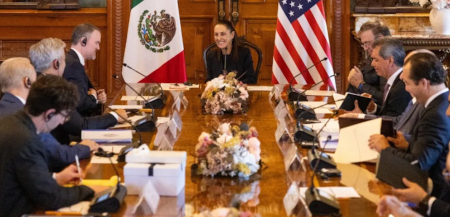
talk USMCA, April 20, 2026
In May, Greer further explained to CFR president Froman, “I want to have our supply chain sourced from this hemisphere, right? From North America. That’s where we want to have it….And so that does mean that if we can have a group of countries that are more aligned with, you know, our type of external trade policy, it’s much easier to say, all right.”
Last year, after Sheinbaum’s initial proposal for Mexico to match U.S. tariffs, U.S. Treasury Secretary Scott Bessent responded to the news: “I think it would be a nice gesture if the Canadians did it also so in a way we could have Fortress North America from the flood of Chinese imports….”
Given his evasive deal-making style, the statements of Greer and Bessent do not indicate Trump’s ultimate preference for the type of agreement that Canadian and Mexican tariff alignment with the U.S would take. If Trump remains true to his nationalist mandate, he would withdraw from USMCA and insist on separate bilateral agreements, with tariffs on each nation adjusted accordingly.
But “free traders” have hope that, despite his nationalist views, Trump may yet buy in for alignment being a key part of USMCA strengthening. Their pitch, likely directed toward shortsighted vanity, presents the USMCA Fortress plan as simply a projection of Trumpian nationalism across the continent.
Duplicitous and naive
But if this proposal for a great, big, beautiful, continental tariff fortress by “free traders” seems duplicitous, that’s because it is.
“Free traders” have always wanted to eliminate tariffs. Governments, they say, should not intervene and insert protectionist policies into any free market, so that consumers can pay the lowest possible price that sellers are willing to offer. But this key tenet of “free trade” is also naive and misguided, as the following example illustrates:
Suppose, on any street corner, two people are apprehended for openly dealing in stolen merchandise. The seller is from another town, where corruption turns its back on the stealing of merchandise.
The seller scolds the law officer: “Hey, protectionist, you have no right to interfere in a free market. The culture in my town allows me to offer this product at a discount, and buyers should be free to purchase at that price. Your interference will just bring inflation.”
The law officer is unmoved: “What you do in your town is your business, but you’re not bringing that kind of business into our town. Get in the car.”
The moral significance of this illustration should be clear: Products made in countries using slave/forced labor, or stolen intellectual property, are stolen merchandise, stolen from the labor of those who produce or conceive them. It is the right and duty of all levels of government to police the transaction of such goods within their jurisdiction. This duty is not to impose “big-government interference,” but to protect a truly free market from corruption and distortion of free/fair-market forces.
This duty is ingrained in the U.S. Constitution, Article 1, Section 8:“The Congress shall have Power To….regulate Commerce with foreign Nations….”
Means to an end
So it is evident that “free traders” are advancing a deceptive Fortress North America narrative that contradicts their own arguments for “free trade.” For what purpose is that narrative being advanced?
Chiefly, it is a nod to reality. Despite decades of conditioning from big gov, big business, big media, and big academia, telling us that protectionist nationalism is a relic of xenophobic hayseeds, enough Americans still maintain resistance to the naivety and chaos of “free trade” globalism. They have elected Trump more than once to reject it.
Enemies to free markets and free societies still exist within governments, even if they do so behind a facade of “free trade.” They exploit their populations and labor forces, and would expand to exploit other societies if enriched enough to do so. Americans who understand this reality – thus far represented by President Trump – are the hurdle that “free trade” globalists must overcome.
So, “free trade” globalists are resorting to expediency and deception to further their cause. In the near term, they are willing to tolerate – and even promote – a common external tariff policy around North America, in order to advance tariff-free open borders within the region, which would accelerate further integration of the continent under USMCA.
“Five levels of economic integration”
A deeper dive into reality reveals that this deceptive incrementalism has been the stated method to achieve EU-style economic-political integration in all other regional blocs on earth.
“The five levels of economic integration,” taught for decades in international business and global studies programs in major universities throughout the world, outlines the incremental steps that advance a multilateral trading bloc at its own pace toward a full economic-political union. The current USMCA agreement is only at level one. The template model EU, even with its current strong control of European nations, is not fully at level five.
How would advancement through the steps be achieved? Economic-security threats and competition from other regions would trigger crisis, clamor, and urgency within each regional bloc to move to its next level. Does that sound familiar with USMCA?

Look at step two: It is particularly the threat from China, empowered by “free trade” investment into China decades ago, that forms the pretext for the current campaign for a USMCA common external tariff.
That is also how, reacting to the Soviet threat in the 1950s, the European Coal and Steel Community common market began to grow incrementally into the European Economic Community, and finally into the current European Union.

Another major example of the advancement through these levels is occurring at the present hour with the nations of the Gulf Cooperation Council (GCC) on the Arabian Peninsula. The globalist World Economic Forum (WEF), founded by Klaus Schwab with BlackRock’s Larry Fink as current chairman, published a report in January chronicling and lauding the GCC’s move through these very same stages, since its founding in 1981.
Starting as a simple “free trade” agreement, Arab Gulf nations are now setting their sights on monetary union, with a common currency like the EU’s euro. The current crisis with Iran is prompting Arabs to urge the bloc to go even further, to a Gulf confederation.
Regions: watered-down version of globalization
Schwab, in his 2020 book, COVID-19: The Great Reset, analyzed the world’s ongoing struggle between the quest for globalism and nationalism’s pushback, writing:
“The most likely outcome along the globalization-no globalization continuum lies in an in-between solution: regionalization.”
Using the European Union and ASEAN (Association of Southeast Asian Nations) as examples, Schwab described them as “important illustrative cases of how regionalization may well become a new watered-down version of globalization.”
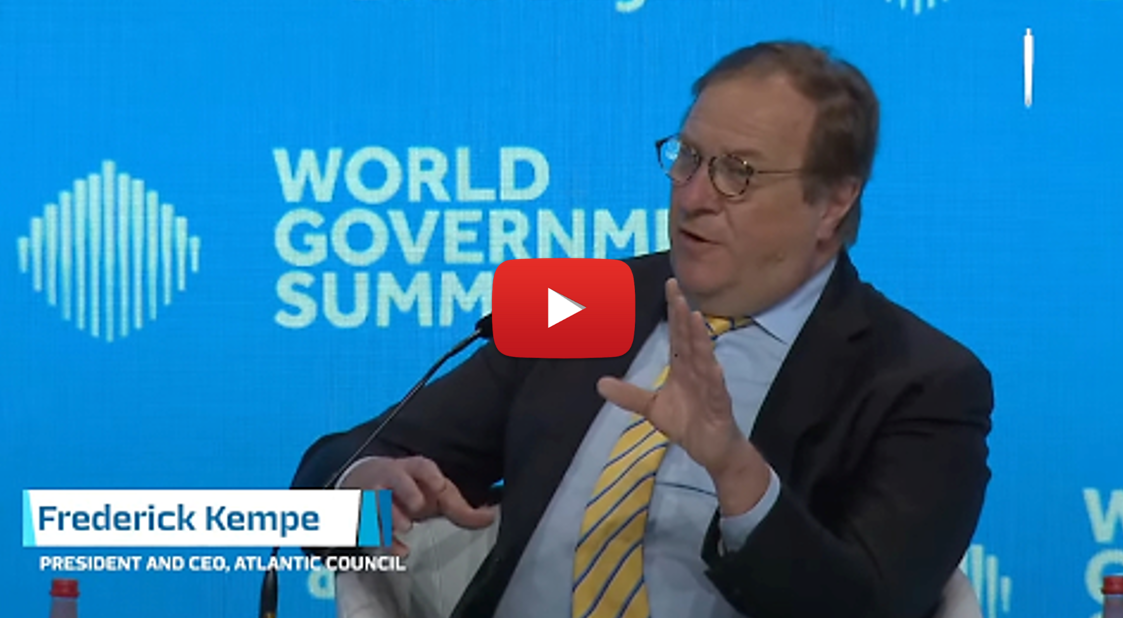
Frederick Kempe, president and CEO of the Atlantic Council (which has six former CIA directors on its board of directors) agreed, commenting at the 2022 World Government Summit, “I think you’re going to see the evolution of regional organizations, and that regional–because it’s so hard to create a world order–I think you’re going to see regional orders spring up. And then you would have links between regional orders. But they will be very much guided by economic interests, social interests and also security interests….”
The new mercantilism
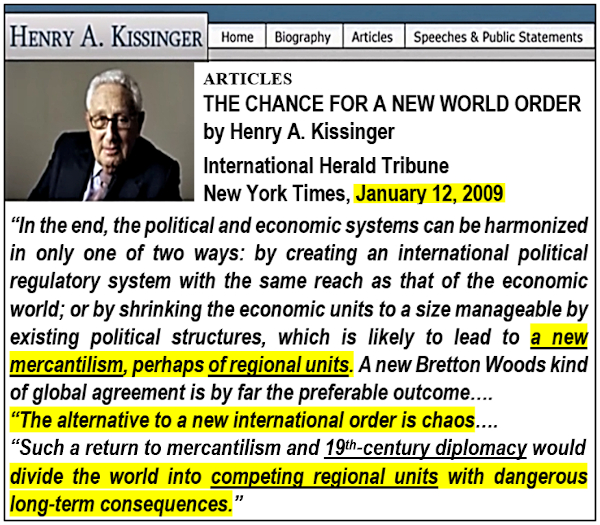
Former Nixon-Ford Secretary of State Henry Kissinger succinctly summarized the regional-order dynamic in his 2009 New York Times op-ed, The Chance for a New World Order. Written as a solemn warning and veiled threat, globalist Kissinger declared that the world will either accept an “international political regulatory system” (i.e., de facto world government) in the near term, or it will likely face the reality of a “new mercantilism” of “competing regional units.”
One need not look very hard to see this dynamic being played out in today’s world. On its face, a Fortress North America would certainly qualify as a competing regional unit in Kissinger’s new mercantilism. As similar region-building projects develop within regional blocs throughout the world, the globalist end game becomes clear.
Under historic mercantilism in the age of competing European colonial empires, it was strong economic and military threats from other empires that formed the very pretext for consolidation of resources and expansion of power within each empire. Thus the age was characterized by a “resistance training” system that benefited, strengthened, and sustained all empires simultaneously.
Today, globalists are determined to play out Kempe’s regional-order scenario in the same manner, until Kempe’s second scenario can occur: “….And then you would have links between regional orders.” – And then you would have world order, under a global federation of regions.
This very scenario was foretold even as far back as 1962, by Lincoln P. Bloomfield Sr., former State Department official and long-time globalist political science professor at MIT. Bloomfield was tasked under contract with the State Department to prepare a feasibility study with a scenario describing how a global government could develop.
His report, “A World Effectively Controlled by the United Nations,” summed up the entire incremental process, starting from nations’ levels of integration into regional blocs, and finally to expansion of jurisdictions into a global structure of government. Bloomfield wrote:
A “normal” historical process, in which ever-larger units evolve through customs unions, confederation, regionalism, etc., until ultimately the larger units coalesce under a global umbrella, could take up to two hundred years, on past performance figures, and even this may be optimistic….I have suggested that an alternative road may bypass the main path of history, shortcircuiting the organic stages of consensus, value formation, and the experiences of common enterprise generally believed to underlie political community. This relies on a grave crisis or war to bring about a sudden transformation in national attitudes sufficient for the purpose. According to this version, the order we examine may be brought into existence as a result of a series of sudden, nasty, and traumatic shocks….
Bloomfield’s description of “traumatic shocks” to accelerate the process is a “house divided” strategy for world order. That process is certainly destined to fail, but not before populations endure much pain and suffering at the hands of deranged minds.
It is only by becoming more aware of this strategy, and by beseeching God’s Holy Spirit to restrain it – through His people who are willing to reprove it – that this global assault upon nations can be held in check.
USMCA doesn’t need to be strengthened. It needs to be terminated.



.
.