

USMCA
RELATED NEWS WIKIPEDIA
USMCA ISSUES INDEX
Here is an index of what is where in the original agreement, along with the specific chapters, including page numbers, annex pages, and side letters:
‘REGIONAL PROTECTIONISM’ PRECURSOR TO NORTH AMERICAN CUSTOMS UNION?

Canada PM backs ‘fortress North America’ ahead of US trade talks
Digital Journal | AFP, May 28, 2026 – Canadian Prime Minister Mark Carney stressed his country’s importance to the US economy on Thursday, urging closer cooperation as talks on revising the North American free trade agreement face roadblocks….
Carney has been one of the most prominent critics of Trump’s leadership, but on Thursday sought to emphasize the benefit of regional economic integration ahead of a July 1 deadline to revise the United States-Mexico-Canada Agreement (USMCA).
TERMINATE USMCA
by Tim Porter, CircumspectNews.com
The 2020 ratification of the USMCA “free trade” agreement,” scheduled for review in 2026, created a “problem”: China and others have circumvented U.S. customs protection via import dumping into Mexico and Canada.
But the “solution” currently being offered by U.S. Trade Representative Jamieson Greer is even further integration, by “enhancing economic security alignment on tariffs.”
Treasury Secretary Scott Bessent also favors tariff alignment into a “Fortress North America” economic security bloc.
Incredibly, this incremental regionalism-globalism is being perceived as an assertion of Trumpian U.S. nationalism across the continent.
A fully aligned, common-external-tariff structure among the three North American nations would constitute a “customs union.” That would be level two of the “five levels of economic integration,” taught in international business and other programs at universities throughout the world.
The USMCA “free trade” agreement is level one:
This would take North America another step down the same incremental, Hegelian-dialectic, crisis-creating path upon which Jean Monnet pushed European nations to bring about the European Union.
In that regard, the “five levels of economic integration” is a misnomer. The more accurate label is “five steps to political union,” in which national sovereignty would be incrementally surrendered – via “free trade” – to the world’s multinational, regional blocs.
USMCA doesn’t need to be renegotiated. It needs to be terminated.
‘ECONOMIC UNION’ IS LEVEL 4 of 5 (USMCA IS LEVEL 1):
Canadians want an ‘economic union,’ says Kevin O’Leary
VIDEO: FOX BUSINESS – The Evening Edit, Feb 10, 2025
“Join the two economies, become a behemouth–common currency perhaps–and then take on China”
US would gain access to Canadian resources ‘in a free flow — no tariffs’
Fortress North America is replacing free trade in Canada’s lexicon
Policy Options (Canada) May 11, 2026 – Goldy Hyder, president of the Business Council of Canada, leaned into his microphone and told the room that “Fortress North America” was already the phrase American policymakers were using. Ontario Premier Doug Ford had for months been road-testing “Fortress Am-Can” to describe a potential “renewed strategic alliance.” By December, U.S. witnesses at the hearing were turning that proposal into a demand. “We should be building Fortress North America,” said the American Kitchen Cabinet Alliance….
The vocabulary Canada endorsed in Washington does not stay in Washington. “Fortress North America” is a framework that defines Canada’s value to the United States as conditional on continuous alignment with American economic security priorities. Ford’s Am-Can growth plan says it explicitly: Any USMCA member should “match or exceed U.S. tariffs on Chinese electric vehicles and other strategically important products or lose its seat at the table.” That sentence was written by Canadians. It will be quoted back to them.
China’s Role in the USMCA Review
Summary of recent lobbyist submissions to U.S. Trade Rep Greer before 2026 USMCA review
Baker Institute (Rice University), Jan 20, 2026 – ….After receiving the comments and holding the hearing, U.S. Trade Representative Jamieson Greer reported to the relevant congressional committees on the Trump administration’s preparations for the USMCA review….
In a submission reflective of general domestic industry concerns, the Alliance for American Manufacturing (AAM) …. said “Canada and Mexico should accelerate their ongoing efforts to align their trade policies with U.S. measures on tariffs….
Silverado, a think tank, argued for “a diversified North American supply chain that reduces reliance on China,” with several specific suggestions:
1. Adopt unified external tariffs on Chinese critical mineral inputs, equipment, and downstream products….
2. Implement a common transshipment tariff modeled after the July 2025 U.S. measures to address duty circumvention.
3. Establish rules of origin for minerals mined, processed, recovered, or recycled in North America to incentivize regional demand through preferential tariff treatment….
A final area for possible changes as part of the USMCA review is something along the lines of the common external tariff called for by various stakeholders. While perfectly coordinated external tariffs among all three USMCA governments may be unlikely, the recent moves by Canada and Mexico to increase some of their tariffs so that they are better aligned with U.S. tariffs indicates that this idea has some government support. On this issue,Greer’s report to Congress notes that Mexico’s tariffs on imports from non-FTA partners was an example of Mexico taking “significant concrete steps to address our concerns.”
US Trade Rep Greer: ‘Successful’ USMCA review to include regional tariff ‘security alignment’
CRITICAL MINERALS, ‘ECONOMIC SECURITY ALIGNMENT’ MAY REQUIRE ‘TRILATERAL APPROACH’
Opening Statement for House Ways and Means and Senate Finance Committees Ambassador Jamieson Greer, United States Trade Representative December 16 and 17, 2025
Office of the United States Trade Representative, Dec 17, 2025
“…. We received 1,514 comments from a wide range of stakeholders, and my team has worked hard these last few weeks to read and analyze each comment.
“In their comments, many stakeholders expressed support for the USMCA and many explicitly called for the Agreement to be extended. However, at the same time, virtually all stakeholders also called for some sort of improvement to the Agreement….
“In negotiating firmly, USTR will engage with Mexico and Canada to determine which shortcomings can be addressed on a bilateral basis and which require trilateral resolution. Already, USTR’s engagement with Mexico has demonstrated the effectiveness of focused, bilateral work. But to tackle some issues, such as rules of origin, critical minerals, or economic security alignment, a trilateral approach may be required.
“Whatever the format, the Joint Review will depend on the successful resolution of the following, non-exhaustive, list of issues:….
For both countries [Canada and Mexico]: ….
• Enhancing economic security alignment on tariffs, export controls, and investment screening;….”
Opinion: If Trump’s trade target is a customs union, Canada will have a big decision to make
CANADA, MEXICO WOULD MATCH U.S. TARIFFS IN ‘FORTRESS NORTH AMERICA’ CUSTOMS UNION

The European Customs Union, established in 1968, was the “cornerstone” of today’s European Union
Financial Post (Canada), Aug 8, 2025 – The Trump administration has referred in the past to the idea of creating a “Fortress North America” as a means of counteracting the threat from China.
As such, a major trade irritant for the U.S. has been third countries’ use of Canada and Mexico to circumvent tariffs, with China, for example, making significant investments in manufacturing in Mexico, evidenced by the foreign direct investment data.
With that in mind, one of the aims of the U.S. administration with the CUSMA [USMCA] renegotiation could be to move from a Free-Trade Agreement to something that more closely resembles a customs union. Such an arrangement would mean that Canada and Mexico would have to commit to match the tariffs the U.S. imposes on every other country, potentially leading to a difficult choice for Canada. Nevertheless, it’s important to remember that the European Customs Union, established in 1968, was a cornerstone in the creation of what is now the European Union.
A customs union would mean further integration with the U.S., guaranteeing access to its market, but it would come at the expense of lost independence. As such, Canada’s current free-trade agreements with other countries, such as CETA, the TPP and others, would no longer be valid. Moreover, Canada would lose its ability to negotiate free trade deals with other countries….
US unveils ‘Greater North America’ strategy to redefine regional security
‘From Greenland to Ecuador and from Alaska to Guyana’ within ‘immediate security perimeter’
Business Standard, Updated March 30, 2026 – US War Secretary Pete Hegseth on Sunday (local time) outlined a new geopolitical framework, naming it the “Greater North America” strategy, describing it as a redefinition of regional security under President Donald Trump’s leadership.
Speaking at the US Southern Command headquarters in Doral (Florida), Hegseth said the administration’s strategic vision stretches “from Greenland to the Gulf of America to the Panama Canal,” encompassing all sovereign countries and territories north of the equator within “immediate security perimeter.”
Bessent Calls on Canada to Match Mexico’s Pitch on China Tariffs
Bloomberg: The Close, Feb 28, 2025
Mexico has proposed matching US tariffs on China, Bessent says
BESSENT: ‘IF THE CANADIANS DID IT ALSO…WE COULD HAVE FORTRESS NORTH AMERICA’ FROM CHINESE IMPORTS
Reuters, Feb 28, 2025 – U.S. Treasury Secretary Scott Bessent said on Friday that Mexico has proposed matching U.S. tariffs on China in a move that he described as “very interesting” and one that Canada should match.
“I think it would be a nice gesture if the Canadians did it also so in a way we could have fortress North America from the flood of Chinese imports that’s coming out of the most unbalanced economy in the history of modern times,” Bessent said in an interview with Bloomberg TV.
Kevin O’Leary weighs in: Could Canada become the 51st US state?
Is Greenland the next frontier for AI infrastructure?
NORTH AMERICA, EUROPE AND ‘STRATEGIC RESOURCE COMPETITION’
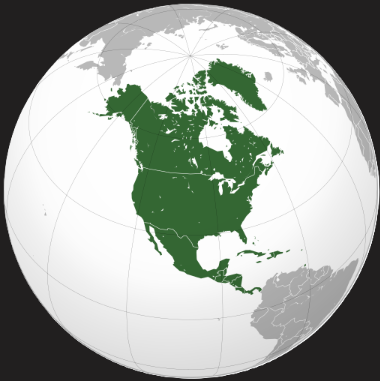

World Construction Network, Jan 21, 2026 – Given Greenland’s strategically positioned location – between North America and Europe – the territory has long been recognised by US policymakers as critical to national security….
However, Trump’s interest in Greenland may reflect more than geopolitics. It could also align with a drive to secure access to critical minerals needed for next-generation technology infrastructure, including large-scale AI data centres and power grids. Greenland is known to have vast endowments of critical minerals…. As a result, this places Greenland at the centre of strategic resource competition.
CANACERO Supports Sheinbaum’s Strategic Steel Tariff Reforms
MEXICO STEEL INDUSTRY ASSOCIATION’S STRATEGIC ALIGNMENT WITH [U.S.] PROTECTION POLICIES
Discovery Alert, Dec 17, 2025 – The tariff framework’s differentiated treatment of USMCA partners versus non-agreement countries demonstrates efforts to maintain regional trade integration while protecting against external competition. This structure preserves North American manufacturing partnership while building domestic resilience….
Strategic trade partnership implications extend beyond immediate tariff impacts to broader questions of North American economic integration.
Mexico Imposes Up to 50% Tariffs on Asian Imports Ahead of USMCA Review
TO SHOW COMPLIANCE WITH NORTH AMERICAN TRADE PRIORITIES
The 420, Dec 12, 2025 – In a dramatic policy reversal, Mexico’s Senate has approved a new tariff regime imposing duties of up to 50 per cent on more than 1,400 products imported from countries without a formal trade agreement, including India, China, South Korea, Thailand, and Indonesia….
The move poses a significant challenge for Indian exporters … which have relied on Mexico as a strategic entry point into the North American market….
Trade observers believe Mexico’s abrupt move toward protectionism is linked to mounting pressure from Washington ahead of the 2026 USMCA review….
The move also underscores a broader North American shift toward protectionism, with both the U.S. and Canada tightening oversight of imports tied to Asian supply chains.
Mexico plans 50% tariff on Chinese cars before US, Canada talks
‘SUGGESTS CREATING A COMMON BLOC AGAINST CHINA’
WTO Center, Sep 12, 2025 – Mexico plans to impose tariffs of as much as 50% on cars and other products made by China and several Asian exporters, aligning the country more closely with US protectionism….
“It’s a protectionist measure, very much in Trump’s style, that suggests creating a common bloc against China. It’s to be expected ahead of the review of the USMCA,” said Gabriela Siller, director of economic analysis at Mexican bank Banco Base.
“COMMON EXTERNAL TARIFFS” IS LEVEL TWO OF “THE FIVE LEVELS OF ECONOMIC INTEGRATION”

Regional tariffs could soon be the new ‘reciprocal’ tariff
BESSENT: ‘WE WILL DO A LOT OF REGIONAL DEALS’
CNN Business, May 23, 2025 – As Trump’s self-imposed July 9 deadline for when “reciprocal” tariffs would resume inches closer, just one deal with the United Kingdom has so far been announced. Trump and administration officials are starting to hint at cracks in their plan to get individualized trade deals done in time….
In a Sunday interview with CNN’s Jake Tapper, [Treasury Secretary Scott] Bessent alluded to a regional tariff scheme under consideration. “My other sense is that we will do a lot of regional deals: ‘This is the rate for Central America, this is the rate for this part of Africa,’” he said….
So, shifting to a system where countries are grouped together under blanket tariff policies risks, in some cases, throwing out the baby with the bathwater for countries whose trade practices are less disturbing to the administration…
But grouping countries together poses another risk: It gives them more ammunition to retaliate against the United States than if the individual countries were on their own….
Opinion: We Are One Step Closer to Fortress North America

REGULATORY ALIGNMENT, STRONGER BORDER, PARALLEL TARIFF STRATEGIES
Farm Journal AgWeb, April 4, 2025 – Fortress North America is a concept where Canada and Mexico are more entrenched with the United States than they have ever been. It involves deeply integrated supply chains, shared trade and security interests, regional self-reliance on critical commodities and goods, and mutually aligned trade protections versus economic foes.
Whether it is regulatory alignment, stronger border enforcement, or parallel tariff strategies, Canada and Mexico are going to be pushed to think more about North America over the European Union, Asia, or South America over the next four years, and possibly beyond….
This may be the first you have heard this “Fortress North America” term, but it has been around for a while. For many of you, tying Canada into a deeper U.S. relationship fresh off of the 51st state threats seems counterintuitive, but the numbers speak for themselves….In a multipolar world, Canada cannot ride the fence and will be forced, due to its American adjacency to choose its economic partner.
THE ‘NEW MERCANTILISM’:
Opinion | Is Trump’s ‘Fortress North America’ a coherent foreign strategy or just more gamesmanship?
“CROSS BETWEEN THE LATE 19TH CENTURY AND ORWELL’S ‘1984’”
Hamilton Spectator (Canada), March 7, 2025 – It’s the consolidation of the new American empire, in a world that suddenly starts to look like a cross between the late 19th century and Orwell’s “1984.” There will be the spheres of influence of the three superpowers: Oceania (the Americas), run from Washington; Eurasia, run from Moscow; and Eastasia, run from Beijing — all perpetually or at least periodically at war with one another. South Asia and Africa will be disputed colonies or borderlands, and that’s where most of the wars are actually fought.
Not the 51st state, but maybe a ‘North American Superstate’?
TRUMP’S PROVOCATIVE POSITION ‘OPENS UP A DISCUSSION ON NEW WAYS OF THINKING’
Financial Post (Canada), Feb 21, 2025 – In the atmosphere of political conflict created by United States President Donald Trump it is hard, even impossible, to understand what his administration’s objectives are. His confrontational style has unleashed a global wave of uncertainty and instability that is shaking nations and international institutions, from Ukraine to Europe and Asia. Nobody knows that experience better than Canadians who have been grappling with Trump’s consistent and demeaning claim to want to turn Canada into “the 51st state.”….
In the view of U.S. historian Arthur Herman, the great potential is to forge an economic alliance between the United States and Canada…. And here Herman borrows a phrase created more than half a century ago by Herman Kahn, founder of the Hudson Institute. Through economic co-operation, Canada, the United States — and Mexico — would create a “North American Superstate.”
Herman is quick to acknowledge that the superstate’s structure is economic, not political….
[Oh, sure. This “economic union” would follow the exact incremental path that the European Union took to becoming the bureaucratic monolith that now usurps sovereignty from its member nations.]
MADE IN NORTH AMERICA:
USMCA Auto Parts Free From Trump’s Tariffs
AUTO PARTS HAVE ZERO TARIFFS
Carscoops, May 6, 2025 – Mexico is pleased with the USMCA exemption, as it is the largest importer of auto parts into the United States. Mexican President Claudia Sheinbaum described the exemption as “good news,” adding…. “There’s a preferential treatment for everything that is produced within the trade agreement, and in particular for auto parts, which have zero tariffs.”
Trump’s tariffs: What does it mean to be made in America?
USA Today, March 2, 2025 – Negative portrayals of the southern border are common, as in the president’s executive order describing the region as “overrun by cartels, criminal gangs, known terrorists, human traffickers, smugglers, unvetted military-age males from foreign adversaries and illicit narcotics that harm Americans.”
But this region has also played host to an economic transformation over the past 25 years that has interlaced the U.S., Canadian and Mexican economies in a way that lets North America compete with China, experts say….
Factory wages in Mexico are a fraction of what they are in the U.S. Along Mexico’s northern border, the minimum wage is 50% higher than in the rest of the country, but workers still earn roughly $2.62 per hour, or roughly $21 per day, at the current exchange rate.
COMMENTARY: BETTER TOGETHER: USMCA AND NORTH AMERICAN CRITICAL MINERAL FLOWS
Brookings, March 5, 2025 – The minerals and metals needed to support the modern economy are one of the most economically and geopolitically significant supply chains—as evidenced by President Donald Trump highlighting the need to “assess the national security implications of the Nation’s mineral reliance” in his executive order declaring a national energy emergency.
ELON’S GLOBALIST ADVICE:
OPEN CONTINENTAL BORDERS?
Musk says he wants a free-trade zone between Europe and North America
‘FREEDOM OF PEOPLE TO MOVE BETWEEN EUROPE AND NORTH AMERICA’
‘THAT HAS CERTAINLY BEEN MY ADVICE TO THE PRESIDENT’
AFP News Agency, April 6, 2025 – “I hope it is agreed that both Europe and the United States should move, ideally, in my view, to a zero-tariff situation, effectively creating a free trade zone between Europe and North America. And that’s what I hope occurs.
“And also, more freedom of people to move between Europe and North America, if they wish. If they wish to work in Europe or wish to work in America, they should be allowed to do so, in my view.”
Mexico creates nearshoring incentives in push for regional integration
LONG-TERM PLAN TO BOLSTER MEXICO’S ROLE IN NORTH AMERICA’S SUPPLY CHAINS
Supply Chain Dive, Jan 24, 2025 – The package’s goals would include strengthening the national economy while increasing regional integration, jobs, pay and overall wellbeing, Sheinbaum said. Furthermore, it would help Mexico substitute imports with domestically produced goods….
Broadening the funding was necessary to push domestic companies of all sizes to better integrate into regional supply chains, according to the decree.
Sheinbaum ‘ready’ for dialogue with Trump administration
BELIEVES INTEGRATION OF ECONOMIES ALLOWS NORTH AMERICA TO ‘BETTER COMPETE’ WITH OTHER REGIONS OF WORLD
Mexico News Daily, Jan 15, 2025 – Asked how the federal government would “combat” Trump’s pledge to impose a 25% tariff on all Mexican exports to the United States, Sheinbaum responded that her administration would “have dialogue with the United States government,” but didn’t say how soon it would occur.
DONALD TRUMP’S ‘BOMBASTIC’ TALK OF ANNEXING CANADA IS ABOUT FORMING ECONOMIC UNION, KEVIN O’LEARY SAYS
The Globe and Mail (Canada), Jan 13, 2025 – Mr. O’Leary, also a reality TV star, has visited the U.S. president-elect at his Mar-a-Lago residence in Florida a number of times since Mr. Trump won the 2024 presidential election, most recently with Alberta Premier Danielle Smith this past weekend.
Donald Trump’s ‘bombastic’ talk of annexing Canada is about forming economic union, Kevin O’Leary says
Mr. O’Leary said one idea that was discussed multiple times during his meetings at Mar-a-Lago was getting rid of Canadian tariffs on U.S. imports and a removal of interprovincial trade barriers.
His vision would include a common currency between Canada and the United States and granting Canada as many as two seats on the board of governors of the U.S. federal reserve system.
MEXICO’S SHEINBAUM LAYS OUT PLAN TO CUT CHINESE IMPORTS IN APPARENT NOD TO TRUMP
Reuters, Jan 13, 2025 – Mexican President Claudia Sheinbaum on Monday rolled out an economic plan aimed at curbing imports from China in an apparent nod to U.S. President-elect Donald Trump and his allegations that Mexico is a back door for Chinese goods entering the United States….
The plan includes boosting local sourcing for industries reliant on Chinese imports, like textiles and autos….
Sheinbaum also plans to bump investments up to 28% of GDP, adding 1.5 million manufacturing jobs by boosting local production and cutting red tape.
Mexico plans to boost its position using trade agreements, tariff policies and strengthening customs enforcement, a government presentation showed.
Kevin O’Leary says he wants to talk to Trump about a U.S.-Canada ‘economic union’
‘NORTH AMERICAN EQUIVALENT TO THE EUROPEAN UNION’ – SOURCE OF DISCUSSION FOR DECADES
Comments come after repeated statements by Donald Trump encouraging Canada to become ‘our 51st state’
National Post (Canada), Dec 27, 2024 – “What is of interest and what has caught the imagination of Canadians is an economic union beyond what we have now….” Leary told the Post….
“There’s obviously a lot of issues and more details, but what this could be is the beginning of an economic union. Think about the power of combining the two economies, erasing the border between Canada and the United States and putting all that resource up to the northern borders where China and Russia are knocking on the door.”
The idea of deeper integration between Canada and the U.S., and sometimes Mexico, has been a source of discussion for decades, often compared to a North American equivalent to the European Union, with a shared currency and identification papers. O’Leary pitched similar ideas for an “economic union” during his Fox Business appearance.
CANADIAN ‘SHARK TANK’ STAR KEVIN O’LEARY SAYS HE’S GOING TO MAR-A-LAGO TO CONVINCE TRUMP TO MERGE US AND CANADA
COMMON CURRENCY, TAXES, ‘NEW, ALMOST EU-LIKE PASSPORT’
Gateway Pundit, Dec 27, 2024 – O’Leary continued, “Think about the power of combining the two economies, erasing the border between Canada and the United States and putting all that resource up to the northern borders where China and Russia are knocking on the door. So secure that give a common currency, figure out taxes across the board, get everything trading both ways, create a new, almost EU like passport.”
‘SHARK’ TANK’ STAR KEVIN O’LEARY SUPPORTS TRUMP’S IDEA TO MAKE CANADA THE 51ST US STATE: ‘POTENTIAL IS MASSIVE’
‘CONCEPT OF AN ECONOMIC UNION HAS BEEN BANDIED AROUND FOR 40 YEARS’
Fox Business, Dec 27, 2024 – “There are 41 million of [Canadians] who want to know more, want to understand what the proposal really is, because the concept of an economic union has been bandied around for 40 years. And it makes sense because the resources Canada has, the U.S. needs. Particularly power and water,” O’Leary explained.
“I think in this kernel of an idea and yes, maybe it was a joke to start. There is something great here to be done because if you figured out a way to put these two countries together, it would be the most powerful country on Earth, the most powerful military on Earth, the most powerful resources, and no adversary anywhere would mess with it. That’s the prize.”
‘FORTRESS NORTH AMERICA’: Globalist Wilson Center pushes NA ‘customs union’
‘A Case for a North American Common Tariff’
‘TO HELP KEEP NORTH AMERICA AS THE MOST PRODUCTIVE REGION OF THE WORLD’
Wilson Center, March 19, 2025 – Unlike 35 years ago, today, no consensus exists on how to rank the models of international production. Unexpected supply shocks and the rejection in many countries to subject their trade to rules and bureaucracies distant from their national institutions of popular representation have discredited the global model of the late 20th century. In its place, sub-global production chains emerge, probably leading to less efficient trade but also likely to be more resilient to unforeseen events.17 In this sub-globalized world, anchoring a common tariff with a customs union agreement would contribute more effectively than the USMCA to help keep North America as the most productive region of the world.
MEXICO TO REVIEW CHINA TARIFFS IN POTENTIAL WIN FOR TRUMP
MSN | Bloomberg, March 15, 2025 – Mexican President Claudia Sheinbaum said her country would review tariffs on Chinese shipments, a move that could give the Trump administration a win in its push to build a “Fortress North America” that blocks shipments from the Asian nation.
“We have to review the tariffs that we have with China,” Sheinbaum said at a press conference Thursday.
‘A CONTINENT-WIDE INDUSTRIAL POLICY’?
Toward a Cleaner, Smarter USMCA
Carnegie fellow proposes North American carbon duty, mineral processing, power transmission, Australian, UK membership
By C.J. Mahoney and Peter Harrell, Carnegie Endowment for International Peace, Dec 17, 2024
First….Uniform duties based on the carbon content of steel imported into North America could offer a way to harmonize the three countries’ approach to this issue. The concept might be extended to other carbon-intensive import sectors as well.Second….North American cooperation could be particularly beneficial in developing a viable alternative to Chinese mineral processing….Any negotiations on this front would need to overcome historic Mexican sensitivities about outside influence over extractive industries. Third USMCA negotiations provide an opportunity to align on a strategy for building clean power generation and transmission capacity in North America…. Finally, the negotiation could provide a jumping-off point for the parties to expand cooperation on clean energy supply chains beyond North America, perhaps by offering the carrot of USMCA membership.Two possible candidates would be Australia and the United Kingdom. Trade agreements traditionally have been used to lower tariffs and eliminate subsidies and other market-distorting policies. A joint North American effort to strengthen and relocate supply chains likely would require using some of those previously disfavored tools in pursuit of a continent-wide industrial policy.
Peter E. Harrell is a nonresident fellow at the Carnegie Endowment for International Peace. From January 2021 through 2022, Harrell served at the U.S. White House as senior director for international economics, jointly appointed to the National Security Council and the National Economic Council.
Mexico’s Ebrard proposes North American
‘plan B’ to counter Chinese imports
THE NEXT LEVEL FOR NORTH AMERICAN INTEGRATION:
‘UNIFORM TARIFFS’?
Five levels of economic integration (click to enlarge)
‘ADDITIONAL PARTNERSHIPS AIMED AT INCREASING MANUFACTURING CAPACITY IN NORTH AMERICA’
Mexico News Daily, Nov 25, 2024 – Do Mexico, the United States and Canada need a common plan to increase manufacturing capacity in North America and reduce reliance on Chinese imports?
Economy Minister Marcelo Ebrard appears to believe they do, and floated the idea that Mexico should take the initiative and propose one to its northern neighbors and USMCA trade partners….
While Ebrard didn’t go into details about what a common North American plan to increase production and reduce reliance on Chinese imports would look like, a likely starting point would be for Mexico, the United States and Canada to have uniform tariffs on Chinese imports.
ARE CANADA AND MEXICO DOING ANYTHING TO SAFEGUARD THEIR ECONOMIES FROM SLAVE AND CHILD LABOUR?
CUSTOMS DE MINIMIS EXEMPTION ALLOWS GOODS VALUED UNDER $800 TO ENTER U.S. DUTY-FREE, UNCHECKED
The Sunday Guardian, Dec 1, 2024 – Under the USMCA trade agreement, Canada and Mexico play pivotal roles in North America’s supply chain. Yet, these countries have become loopholes for Chinese goods entering the U.S. market. Chinese companies often establish operations in Mexico and Canada, using them as staging grounds to circumvent U.S. tariffs and scrutiny….
Beyond safety concerns, many Chinese goods are tainted by forced labour, particularly from regions like Xinjiang….Canada and Mexico are accused of turning a blind eye, allowing these goods to filter through their markets.
TRUMP TARIFFS THREATEN TO CRACK OPEN NORTH AMERICAN ECONOMIES
25-PERCENT TARIFF PLEDGE ON MEXICO, CANADA ‘THREATENS TO UPEND DECADES OF NORTH AMERICAN INTEGRATION’
FOX40 Sacremento, Nov 30, 2024 – But that three-way integration is facing headwinds, not least from Trump, who on Monday threatened United States-Mexico-Canada Agreement (USMCA) partners with 25 percent across-the-board tariffs on day one of his presidency in retaliation for their roles in migration and the illicit fentanyl trade.
HP brace for Trump 2.0 with leadership and supply chain overhaul to NA
PROCUREMENT AUTHORITY CONSOLIDATES IN NORTH AMERICA, ANTICIPATING CHANGES UNDER TRUMP’S PRESIDENCY
DIGITIMES, Nov 25, 2024 – Ernest Nicolas, HP’s Chief Supply Chain Officer, has taken on additional oversight of IT and cybersecurity. As procurement authority consolidates in North America, industry observers speculate Nicolas may become a leading candidate for the CEO role….
Supply chain sources note that HP is one of several brands making personnel adjustments to adapt to anticipated changes under Trump’s presidency, including diversifying production. However, HP’s actions stand out as more proactive and urgent, given its deep integration with Taiwan’s supply chain.
Mexico Scrambles to Replace Chinese Parts Amid USMCA Tensions: ‘We’ll Fight to Stay In!’
Launches campaign to strengthen North American manufacturing
EconoTimes, Nov 24, 2024 – Mexico is urgently revising its trade policies and supply chain strategies amid fears that its role in the U.S.-Mexico-Canada Agreement (USMCA) could be at risk. Rising allegations that Mexico serves as a conduit for Chinese parts entering North America have sparked concerns in Washington and Ottawa, threatening the regional trade bloc’s future stability….
Mexican President Claudia Sheinbaum has launched a campaign to reduce reliance on Chinese imports and strengthen regional manufacturing. Speaking on Friday, Sheinbaum emphasized the importance of fostering domestic production and collaboration with North American firms to replace Chinese-made components.
MEXICAN PRESIDENT FOLDING AFTER JUST ONE PHONE CALL WITH TRUMP
TARIFFS FLOATED BY TRUMP WOULD TARGET MEXICAN EXPORTS
Gateway Pundit, Nov 24, 2024 – Trump reportedly shattered the “cordial” call by bringing up the most pressing issue on U.S.-Mexico relations: the lengthy border between our two countries and the unacceptable state of it.
In rushing to meet the results of Trump’s policies, it’s expected that Mexico may increase immigration enforcement…. And it seems Sheinbaum is not the only Mexican politician that needs to worry.
“That is why Trump went so far as to say during the campaign that if Mexico did not cooperate on these issues,” Montes de Oca continued, “he would make public the U.S. government’s intelligence information on politicians in Mexico who are related to drug cartels.”
North America Needs EU-Style Regime, Says Mexican President
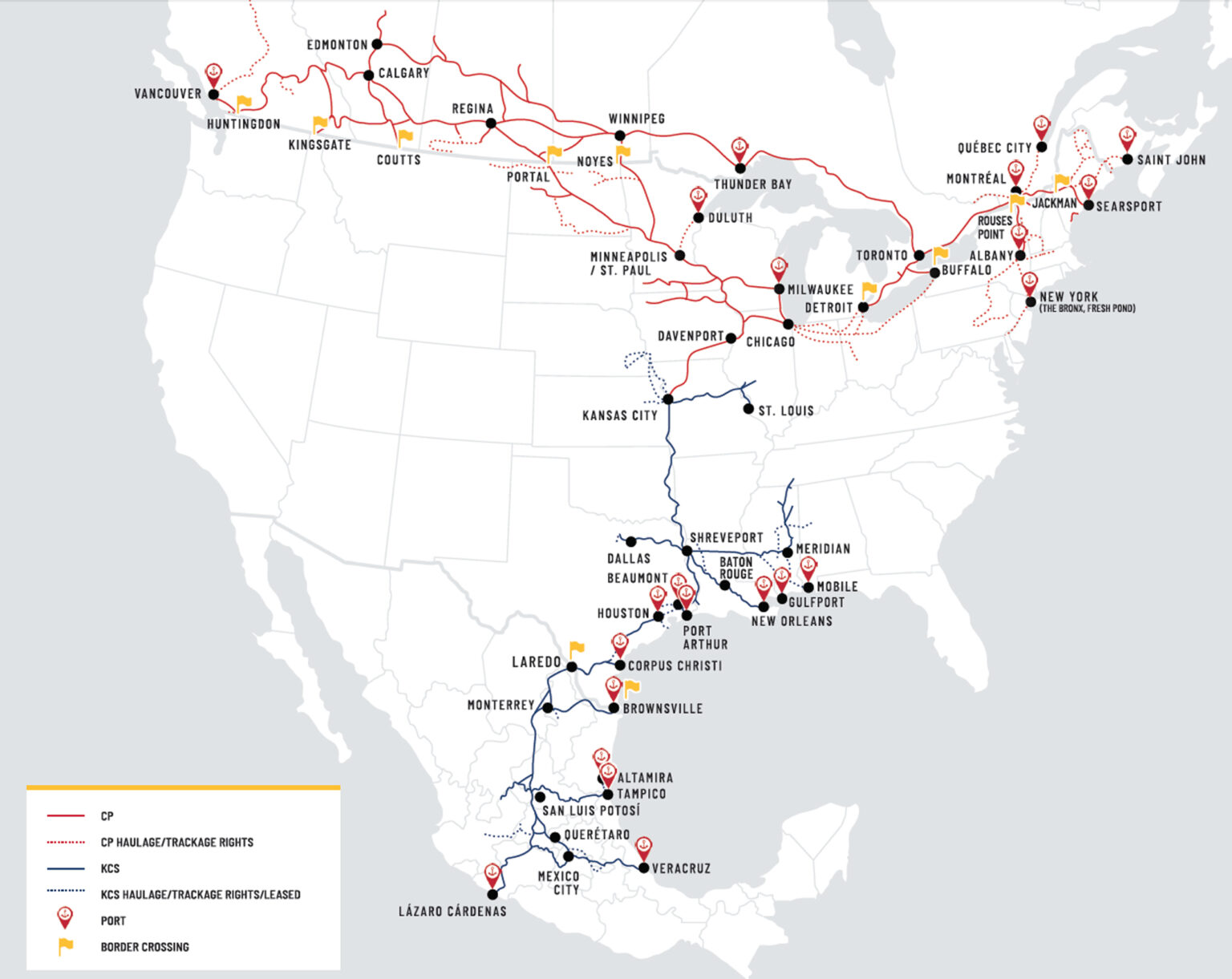
The new Canadian Pacific Kansas City (“CPKC”) railroad, the only single-line railroad linking the United States, Mexico and Canada. Compare this map to NASCO’s proposed “North American Super Corridor,” circa 2007, at right.
Canadian Pacific CEO touts merged railroad
network for unitary ‘nation’ of North America
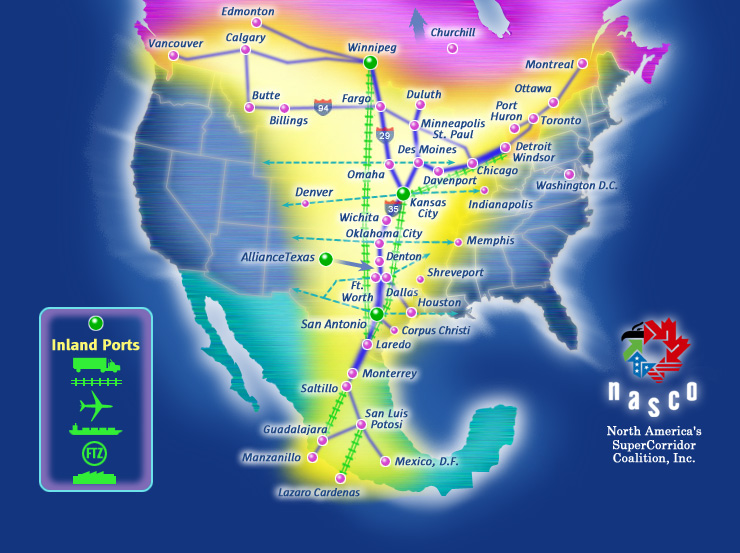
The NASCO (North America Super Corridor Coalition) map of proposed North American transportation corridor, including a “NAFTA superhighway,” circa 2007. Exposure of this key infrastructure component of a “North American Union” was derided as a “conspiracy theory” at that time.
KC SOUTHERN CEO: MEXICO’S BASE OF MANUFACTURING ‘CRITICAL PART’ OF ‘NORTH AMERICAN SUPPLY CHAIN’
FreightWaves, Nov 15, 2022 – Keith Creel, CEO of Canadian Pacific (NYSE: CP), and Patrick Ottensmeyer, CEO of KCS, both highlighted on a screen the map that drove the $31 billion merger that was completed about a year ago. That map shows the roughly Y-shaped network that will be at the heart of the merged companies, extending to both coasts of Canada and down into Mexico. In his remarks, Creel often referred to “nation” in the singular and explained later it was a reference to the more unitary nation of North America — the U.S., Canada and Mexico….
Biden admin calls for North American Union –
Rep. Matt Gaetz responds
2021 NORTH AMERICAN LEADERS’ SUMMIT
‘To Build Back Together as North America’
‘STRENGTHENING NORTH AMERICAN SUPPLY CHAINS BY CREATING A TRILATERAL SUPPLY CHAIN COORDINATION MECHANISM’
WhiteHouse.gov, November 18, 2021 – “To build back together as North America, and for our economies to enhance our competitiveness and propel our future growth, the Leaders affirmed the need for the right conditions for businesses and workers to thrive, and are committed to:
“Strengthening North American supply chains by creating a trilateral supply chain coordination mechanism, with a goal to define essential industries to minimize future disruptions, recognizing that North America needs resilient, sustainable, diverse, and secure supply chains to ensure our economic prosperity and security….”
At Davos, European Distress Over a ‘Made in [North] America’ Law
STIRS TALK OF EU RESPONSE, TRADE WAR
New York Times, Jan 21, 2023 – The U.S. Inflation Reduction Act stirred talk of a trade war, but also proposals for a similar E.U. initiative to stimulate green investment…. The new law, for example, provides buyers of electric vehicles a federal tax credit of up $7,500 — but only if those vehicles are made in North America.
The deception of the New York Times with their ‘Made in America’ headline is despicable. They buried the real truth in the article.
Laredo: $1 Billion Cargo Passes Through Daily | How Mexico is Becoming the New China
USMCA – ‘MADE IN NORTH AMERICA’:
Mexico Publishes Decree Granting Tax Benefits for the Export Industry to Promote Nearshoring
TAX INCENTIVES FOR PRODUCTION, EXPORT TO U.S
National Law Review, Oct 19, 2023 – ….The Decree is designed to support companies operating in Mexico that are identified as key for the export industry and that seek to optimize their operations through the “nearshoring” strategy. With this Decree, the Mexican federal government aims to promote competitiveness, innovation, and investment in technology, and ultimately job creation and direct foreign investment.
The tax benefits included in the Decree will benefit entities subject to the general income tax regime or the simplified trust regime, as well as individuals with business activities in Mexico, involved in the production, processing, industrial manufacturing, and/or export of the following goods:
- Food products;
Fertilizers and agrochemicals;
Raw materials for the pharmaceutical industry;
Electronic components;
Metering and electronic medical equipment, for medical use;
Batteries and accessories for electrical installations;
Gasoline, hybrid, and alternative fuel engines for cars, vans, and trucks;
Automotive electrical and electronic equipment;
Internal combustion engines, turbines, and transmissions for aircraft;
Medical, dental, and laboratory equipment and devices; and
Cinematographic or audiovisual works.
In addition to the “Nearshoring” trend, other trends include “friendshoring” and “allyshoring.” These terms refer to situations where the decision to relocate a production plant is influenced by political factors or common interests between the manufacturing location and the final destination for a product (for example, Mexico and the United States)….
As part of the enactment of the CHIPS Act, Mexico was invited to join efforts in promoting semiconductor manufacturing and to integrate products manufactured within its borders to the semiconductor supply chain in the United States.
Torres: Near-shoring is the hot topic to talk about right now
Chinese manufacturers move to Mexico, evade tariffs by taking advantage of USMCA
‘REGIONALIZATION IS THE ANSWER, AS WE’VE SEEN, AND WE’RE SEEING THE POSITIVE IMPACT OF THAT IN THE NORTH AMERICAN REGION’
Rio Grande Guardian, Sep 1, 2023 – Torres [president, founder, Interlink Trade Services] also spoke about the current trend of Chinese companies moving to Mexico.
“Mexico is becoming the new alternative because it offers proximity to the US, lower labor costs and access to preferential treatment under the USMCA, or the US-Mexico-Canada Agreement,” Torres said.
Mexico’s moment in the sun
‘NEARSHORING’ IS PUSHING FDI IN MEXICO TO RECORD HEIGHTS
fDi Intelligence, June 22, 2023 –
“This is Mexico’s geopolitical moment,” Kenneth Smith Ramos, the country’s former chief negotiator for the US-Mexico-Canada Agreement (USMCA) and partner at legal firm Agon tells fDi. “We are seeing a perfect storm of huge conflicts internationally, such as the war in Ukraine and the US–China trade war, that has created a unique window for Mexico to increase investments and modernise its economy.”….
Mexico has also seen a rise in FDI [foreign direct investment] from Chinese and other Asian corporations looking to circumvent tariffs and become more integrated into the North American market.
MEXICO IS POISED TO RIDE THE NEARSHORING WAVE
Morgan Stanley, June 21, 2023 – As U.S. companies increasingly look to their southern neighbor to bolster their supply and value chains, it is likely to boost Mexico’s GDP growth as investment surges, providing new opportunities for companies and investors alike.
“If U.S. manufacturing is to be less dependent on China, we think the path will be via Mexico,” says Morgan Stanley Research equity analyst Nikolaj Lippmann. “Nearshoring is expected to be a long and sustained race that could help build new ecosystems in Mexico’s existing manufacturing hubs.”
NEARSHORING LEADS TO INBOUND BOOST FROM MECIXO, CANADA
Multichannel Merchant, June 21, 2023 – Mexico and Canada are seeing an increase in manufacturing and shipping to the U.S. as nearshoring takes hold in the face of uncertainty over trade with China…. According to a joint supply chain stability index from management consulting firm KPMG and the Association of Supply Chain Management (ASCM), nearshoring meant the volume of imported freight from Mexico to the U.S. in Q1 exceeded that of China by 15%. The volume from Canada was 5% higher as “China plus one” takes a firm hold.
‘NORTH AMERICAN MINDSET’:
George W. Bush Institute pushes single apprenticeship credential program for continental workforce

‘To support…worker movement across borders’
‘FIRST STEP TO MULTINATIONAL ALIGNMENT FOR APPRENTICESHIPS’
BOLSTERING NORTH AMERICA’S COMPETITIVENESS
The George W. Bush Institute-SMU Economic Growth Initiative, August 2023
Recognizing that harmonization and consistency across borders is essential to efficiency and competitiveness, North American businesses already standardize and streamline their labor practices. A commitment by the three governments to create a unified apprenticeship program would build confidence and attract private sector investment toward a public-private partnership which is necessary to implement the following recommendations:
- The United States, Canada, and Mexico should pilot adopting a single credential within a given industry.• Labor and economic agencies at the Federal and state/provincial levels should partner with private sector and labor interests to inform the creation of this credential.• This pilot credential should be tested with one or more businesses currently hiring and operating in all three countries.• This pilot should lead to the development of a trilateral, North American apprenticeship program. The opportunity to convene the United States Office of Apprenticeships, Mexico’s National College of Technical Professional Education (CONALEP), and Canada’s Excellence in Manufacturing Consortium (EMC) around a single credential within a given industry is the first step to multinational alignment for apprenticeships.
REGIONAL INFRASTRUCTURE – ‘NORTH AMERICAN HIGHWAY’ RESURFACING’:
Ted Cruz legislation passes Senate, would name ‘Ports-to-Plains Corridor’ as ‘Interstate 27’
The Katy News, August 9, 2022 – ….In 2022, Sen. Cruz successfully included language in the fiscal year (FY) 2022 appropriations legislation to designate the portion of the Ports-to-Plains Corridor from Laredo, Texas, to Raton, New Mexico, as a future Interstate route. This was an important step toward adding the route to the U.S. Interstate System. Though the language passed into law in 2022 will add key parts of the Ports-to-Plains Corridor to the Interstate System, it did not give the route an official future Interstate route number.
His latest legislation, which passed out of the Senate in July 2023, would name the Ports-to-Plains Corridor “Interstate 27.”
‘MADE IN NORTH AMERICA’:
Nearshoring tide growing in Mexico
‘FOR NORTH AMERICAN MANUFACTURERS LOOKING FOR PROFITABLE ALTERNATIVES TO CHINA CLOSER TO HOME, MEXICO IS THE OBVIOUS CHOICE’
The Tube and Pipe Journal, July 29, 2023 – Before 2020, anyone suggesting to a manufacturer’s board of directors that they ditch China for Mexico would likely have been shown the door, possibly to the sounds of laughter.
No one’s laughing now….
COVID-19 created such worldwide shipping delays that even companies long entrenched with a make-it-in-China mindset began formulating what’s come to be known as nearshoring—the movement of suppliers much closer to the North American OEMs they support.
Diplomatic and trade tensions between the U.S. and China have only quickened businesses’ relocation to other nations ready with the necessary workforces and technology. Vietnam and India have emerged as key players here, but for North American manufacturers looking for profitable alternatives to China closer to home, Mexico is the obvious choice.
MEXICO ECONOMIC GROWTH TOPS FORECASTS ON SERVICES AND EXPORTS
Yahoo! Finance, July 31, 2023 – Mexico’s economy grew more than expected in the second quarter as private consumption remains robust and the country benefits from strong exports to the US, its largest trading partner.
Senate agrees to fast-track permitting for border bridges after push from Cruz, TX reps
San Antonio Express-News, July 28, 2023
Would double Laredo Bridge capacity to 16 lanes – 10 lanes for freight from Mexico
KXAN Austin, July 26, 2023
SEN. TED CRUZ (R-TX) promotes “I-27, Ports-to-Plains interstate that will flow from Laredo all the way up to Canada.”
SEN. TED CRUZ VISITS LAREDO’S WORLD TRADE BRIDGE FOR ROUNDTABLE
Laredo Morning Times, July 24, 2023 – Senator Ted Cruz visited Laredo’s World Trade Bridge on Monday, July 24 to participate in a roundtable with Rep. Henry Cuellar, Laredo Mayor Dr. Victor Trevino and other local, state and national leaders addressing the progress made in expediting approval of international bridge projects in South Texas and discussing what comes next….
“Being the No. 1 port of entry in the country, this is very important to us,” Trevino said. “It can compete with the global forces and compete at a world stage. These expansions are important so that we are less dependent on unstable markets and competing interests around the world. It also creates more American jobs and strengthens our ties with Mexico and our continent to benefit from this trade and security.”….
Cruz cited his past experience with Cuellar working on the I-27 Ports-to-Plains Corridor as evidence of what can be achieved when attacking an issue from both sides.
“Henry and I work together on a lot of matters. Henry and I worked hand-in-hand on passing the legislation to authorize I-27, the Ports-to-Plains interstate that will flow from Laredo all the way up to Canada.”
NORTH AMERICA and the ‘NEW REGIONAL MERCANTILISM’:
U.S., Mexico and Canada must embrace one another to compete with China, author says

CFR’S O’NEIL: ‘WE HAVE NOT REGIONALIZED ENOUGH’
Dallas Morning News, March 8, 2023 – Is globalization a myth? That’s the argument of Shannon K. O’Neil, vice president and senior fellow for Latin American studies at the Council on Foreign Relations….
As North America tries to lure manufacturing away from China, the U.S., Mexico and Canada need to embrace one another and capitalize on a once-in-a-generation “upheaval that could and should benefit North America, particularly the Texas-Mexico border,” said O’Neil….
“We tend to think globalization is robbing us of jobs. But what’s actually taking jobs away in many ways is that we have not regionalized enough, that we have not tied together in as many or as deep regional supply chains as we’ve seen in other places. We’re competing against Asia, not just China. We’re competing against Europe, not just Germany. And the U.S. is still trying to play this game by itself when the rest of the world is playing on a team.”
OPINION: IT’S NORTH AMERICA’S MOMENT IN WASHINGTON
Yahoo! Finance, March 9, 2023 – At their meeting in January, the three North American leaders said they intended “to forge stronger regional supply chains, as well as promote targeted investment” in strategic sectors like semiconductors and batteries. Seeing North America as a competitiveness zone — one that helps producers in all three nations meet or beat foreign competition — is why we did NAFTA in the first place. But it has taken a resurgence of great-power competition, this time with China, to make the United States fully appreciate the benefits of integration with its neighbours….
‘BUY NORTH AMERICAN’
BIDEN SEEKS COMMON GROUND WITH MEXICO, CANADA AT SUMMIT BUT TENSIONS REMAIN
Reuters, Nov 18, 2021 – Sounding an alarm about China, [Mexico President Andres Manuel Lopez Obrador] said during the three-way meeting that greater North American economic integration, including “stopping the rejection of migrants” needed for the U.S. and Canadian labor forces, would be the best way to face “the productive and commercial expansion of China.” Lopez Obrador’s suggestion echoed Mexican Economy Minister Tatiana Clouthier’s call for the United States to “buy North American” instead of adopting protectionist measures.
USMCA’s ‘THREE AMIGOS’ MUST HAVE A CHINA FOCUS
Raul Gutierrez, WTMZ-TV, Nov 18, 2021 – ….We operate an extensive North American supply chain. For example, we buy U.S. scrap metal, recycle it, and process it in our mills in Mexico to produce steel that is then shipped back to our U.S. facilities to make nails and other wire products. Others maintain even more elaborate supply chains to produce cars and trucks.In their deliberations today, the three leaders can deploy a powerful tool to meet the challenges of unfair economic practices. They can strengthen North American supply chains like ours and substitute them for longer and more fragile chains that extend to China and other distant parts of the world.“For the U.S., the most logical solution would seem to be to look to its North American neighbours,” said a report by The Economist Intelligence Unit. “Proximity is, naturally, a distinct advantage, with much shorter transportation times than those from Asian suppliers….
USMCA-UK?
UK considers joining existing US-Mexico-Canada trade deal as hopes of standalone post-Brexit agreement fade
Sky News, Sept 22, 2021 – A senior government figure suggests an alternative route to boosting trans-Atlantic trade could be the UK joining the existing free trade agreement between the US, Mexico and Canada, known as USMCA.
‘MADE IN NORTH AMERICA’:
Canada Joins Mexico in Seeking Consultation with U.S. Over USMCA Content Rules
AgWeb|Reuters, Aug 30, 2021 – The USMCA, the successor to the North American Free Trade Agreement, requires 75% North American content for a vehicle to be considered as being from North America.
U.S., Mexico, and Canada Sign ‘Progressive’ USMCA Regional Government Scheme
Mexican senator says judges on USMCA bi-nation panels will have ‘regional jurisdiction’
The New American, Dec 11, 2019 – [Senator Ricardo Monreal Ávila of Mexico’s socialist National Regeneration Movement, known by its Spanish acronym MORENA] didn’t waste any time in touting the supranational nature of the USMCA. “It will now be easier to establish panels of regional jurisdiction, or with regional jurisdiction, composed of judges from both countries that address all types of differences that may arise on any subject covered by the treaty,” Monreal proclaimed.
The “regional jurisdiction” Monreal described would operate outside the established judicial systems or courts of Mexico, the United States, and Canada and not be subject them — thus potentially subordinating U.S. citizens and companies to these panels in the event of a dispute — much like NAFTA’s international dispute settlement mechanisms or “NAFTA courts.”
….On the subject of integration, Freeland added, “These amendments will ensure that rules-based trade between our three countries will continue to support the economic prosperity of all of our people and the global competitiveness of North America as a region.” (Emphasis added.) In other words, the USMCA is not intended to strengthen the individual competitiveness of Canada, the United States, and Mexico as independent sovereign nations, but as an amalgamated “region,” similar to the European Union’s Eurozone or common market.
R-CALF USA says beef industry ‘ignored’ in USMCA agreement, urges Congress to vote against
No restoration of country-of origin labels (COOL) on imported beef
DRGNews (Dakota Radio Group, South Dakota), Dec 11, 2019 – R-CALF USA, the nation’s largest producer-only cattle trade association that lobbies on behalf of America’s cattle farmers and ranchers released the following statements following announcement of an agreement between House Democrats and the White House on the United States-Mexico-Canada Agreement (USMCA).
“Once again the House of Representatives and the White House have reached an agreement on a measure that will provide windfall profits for Agribusiness giants at the expense of America’s hard-working cattle farmers and ranchers….
“In fact, the new USMCA is worse than the old NAFTA because at least for several years during the old NAFTA American cattle farmers and ranchers received the tool they needed to finally compete against the growing volume of cheaper imported beef and cattle from Canada and Mexico. From 2013 through 2015, mandatory country-of-origin labels for beef empowered America’s cattle producers to finally begin competing against this growing tide of cheaper, undifferentiated foreign beef.
“We’ve asked Congress and the President to, at the very least, restore mandatory country-of-origin labels (COOL) so American cattle farmers and ranchers could compete against the duty-free, cheaper and undifferentiated cattle and beef flowing into our country and depressing our markets.
“We’ve been ignored.
“We should now expect the downward trends caused by NAFTA to continue, if not accelerate, under the USMCA.
Moving Jobs to Mexico Was a Feature, Not a Bug, of NAFTA
By Dean Baker, FAIR, Dec 4, 2019 – The Washington Post (11/21/19) gave readers the official story about NAFTA, diverging seriously from reality, in a piece on the status of negotiations on the new NAFTA. The piece tells readers:
NAFTA was meant to expand trade among the United States, Canada and Mexico by removing tariffs and other barriers on products as they were shipped between countries. The pact did open up trade, but it also proved disruptive in terms of creating new manufacturing supply chains and relocating businesses and jobs.
This implies that the disruption in terms of shifting jobs to Mexico to take advantage of low-wage labor was an accidental outcome. In fact, this was a main point of the deal, as was widely noted by economists at the time. Proponents of the deal argued that it was necessary for US manufacturers to have access to low-cost labor in Mexico to remain competitive internationally. No one who followed the debate at the time should have been in the least surprised by the loss of high-paying, union manufacturing jobs to Mexico; that is exactly the result that NAFTA was designed for.
Economist Dean Baker is a senior economist at the Center for Economic and Policy Research in Washington, DC.
What’s Wrong With the USMCA?
The New American, Nov 5, 2018 – ….Taking the president’s words at face value, one might think that NAFTA is dead and that the USMCA is a huge win for America that will safeguard its national sovereignty. Unfortunately, his rhetoric belies the reality. The pact is even worse than NAFTA regarding undermining American sovereignty and self-determination, in favor of North American integration extending beyond trade to include labor and environmental policies. It is, in fact, so bad that the globalists who had lambasted Trump for renegotiating NAFTA praised him afterward….
Chapter 30 of the USMCA establishes the creation of a “Free Trade Commission,” which is broader in scope and power than the original 1994 NAFTA Free Trade Commission. According to Article 30.2, the USMCA reads,
“The Commission shall”:
(a) consider matters relating to the implementation or operation of this Agreement;
(b) consider proposals to amend or modify this Agreement;
(c) supervise the work of committees, working groups, and other subsidiary bodies established under this Agreement;
(d) consider ways to further enhance trade and investment between the Parties;
(e) adopt and update the Rules of Procedure and Code of conduct; and
(f) review the roster established under Article 31.8 (Roster and Qualifications of Panelists) every three years and, when appropriate, constitute a new roster.
In other words, the USMCA’s Free Trade Commission can make changes to the agreement itself, implement changes to the agreement, change the rules by which it operates, approve who serves on its lower subordinate committees, and oversee the work of those committees like an international bureaucracy or government — all without the consent or approval of Congress….
In fact, a North American Competitiveness Committee is to be established with “a view to promoting further economic integration among the Parties” (i.e., the United States, Mexico, and Canada) and “enhancing the competitiveness of North American exports.” (Emphasis added.) It reads as though the purpose is to make the North American bloc competitive with other trade blocs such as the EU, ASEAN, and Eurasian Economic Union, but of course, this is simply a ploy by the Deep State to abolish the modern international system of sovereign nation-states to, in turn, replace it with a transitional world order composed of interdependent transnational unions, with the view of further global integration toward a socialistic one-world economic union….
The new USMCA’s Free Trade Commission fits the criteria of James Madison’s definition of “tyranny”: Writing in The Federalist, No. 47, Founding Father James Madison stated, “The accumulation of all powers, legislative, executive, and judiciary, in the same hands, whether of one, a few, or many, and whether hereditary, selfappointed, or elective, may justly be pronounced the very definition of tyranny.”
The USMCA underscores the urgent need not only to get out of the original NAFTA but to likewise reject the USMCA and all other so-called trade agreements that erode American sovereignty through the establishment of transnational executive commissions and that subordinate the United States to international regimes such as the United Nations, World Trade Organization, and ILO….
This article originally appeared in the November 19, 2018 print edition of The New American.